Articles
Guides and investigations on choosing, vetting, and rating M&A business brokers — from the team behind the independent broker directory.

How Long Do You Have to Stay After Selling Your Business?
Two weeks full-time, ~150 training hours, a 6–12 month phone window — and the new SBA rule doubling the seller consulting cap to 24 months. What's normal, what's negotiable.

What Is a Quality of Earnings Report — and Do You Need One to Buy a Business?
New since October 1: SBA lenders must order one on every $3M+ acquisition. What the report checks, the $10–25K price tag, and the $168K it catches in a worked example.

What Is SDE? Seller's Discretionary Earnings, Explained in Plain English
The number Main Street deals are priced on: net profit plus owner salary plus add-backs. Maria's café goes from $100K on the tax return to $185K SDE — and a ~$500K price.

Business Broker Listing Agreement Red Flags: 7 Clauses to Catch Before You Sign
Upfront-fee mills, "any buyer" tail clauses, evergreen renewals, fees due before closing — the seven clauses that cost real money, with the $45K fee-base swing.

How Do I Know If a Business Buyer Is Serious? Proof of Funds and the Other Tells
Only 20–30% of listed businesses ever sell, so screening buyers is half the job. Proof of funds, the SBA math a real buyer has already run, and the behavioral tells.

What Happens on Closing Day When You Sell Your Business?
Flow of funds, lien searches, payoff letters, the final walk-through — what actually happens at the table, and why a $450K sale wires about $313K.

Asset Sale vs. Stock Sale: Which Is Better When You Sell Your Business?
Deals under $50M are mostly asset sales — and the structure choice can swing your after-tax proceeds by 10–15% of the price. The plain-English tax map.

How Do I Sell My Business Without My Employees Finding Out?
Blind listings, NDAs before names, staged disclosure — how brokers keep a sale quiet for months, and when (and how) to finally tell your team.

What Is Due Diligence When Buying a Business? The Buyer's Checklist
Financials, legal, operations, people — the full checklist. 46.6% of broken LOIs die on diligence and earnings findings; here's what buyers actually check.

What Is a CIM? How to Read the Book on a Business for Sale
The 30–80 page book brokers write on every listing: what each section really means, where the bodies are buried, and the add-back table to read twice.

The 8 Questions to Ask a Business Broker Before You Sign Anything
Fees, tail periods, marketing plan, buyer screening — the eight questions that separate real dealmakers from listing mills, asked before anything is signed.

What Is an Earnout When Selling a Business?
24% of deals include one, and only about 1 in 5 earnout dollars ever gets paid. How earnouts work, when they make sense, and the SBA rule that bans them.

Can I Get an SBA Loan to Buy a Business? The 2026 Rules
The $5M cap, the 10% equity injection, the 1.15 DSCR floor — how 7(a) acquisition lending actually works now, and what stricter underwriting means for price.

What Is a Letter of Intent When Selling a Business?
Mostly non-binding — except the exclusivity clause that takes you off the market for 106 days on average. What an LOI locks in, and the DSCR math to run first.

Can I Sell My Business Without a Broker?
Yes — no law requires one. The honest break-even math on the 10% fee, when FSBO is genuinely the right call, and the 87%-of-asking benchmark to beat.

How Do I Prepare My Business for Sale? The 12-Month Plan
70% of small-deal owners have no exit plan. Month-by-month prep: clean books, documented add-backs, SBA-proof pricing — and the $37,800 shoebox of missing receipts.

Should I Offer Seller Financing When I Sell My Business?
90% of buyers expect a seller note; only 29% of owners plan to offer one. Normal terms, the new SBA standby rules, and the math on a $432K deal.

What's a Reasonable EBITDA Multiple? By Industry — and Mostly by Size
4–6× at $1M EBITDA, 7–8.5× at $10M, double digits at $100M — why the same dollar of profit is worth twice as much at scale, with 2026 data.

How Long Does It Take to Sell a Business? Real 2026 Timelines
Six to eleven months, stage by stage — where the calendar actually goes, why overpricing fails in underwriting, and what genuinely shortens the clock.

Is There Anywhere to Rate My Business Broker? Every Option, Compared
Google Reviews, Trustpilot, the BBB, Yelp, BizBuySell — what each covers, verifies, and misses, and where individual brokers actually get rated.

How Business Brokers Get Paid: Fee Structures Explained
Success fees, minimums, Double Lehman tiers, retainer traps, and the listing-agreement clauses that decide what you'll really pay.

Burned by a Business Broker: Real Cases That Prove Research Pays
Fake financials, get-rich schemes, upfront-fee mills — documented cases, and the afternoon of research that would have caught each one.

The Top 10 Qualities You Need in Your Business Broker
What actually separates a great broker from an expensive mistake — a practical checklist for sellers and buyers, mapped to our six rating parameters.

How Do I Know If I Can Trust My M&A Broker? 12 Red Flags
Inflated valuations, phantom buyers, mutating fees, and the other warning signs — plus exactly what to do when you spot one mid-deal.
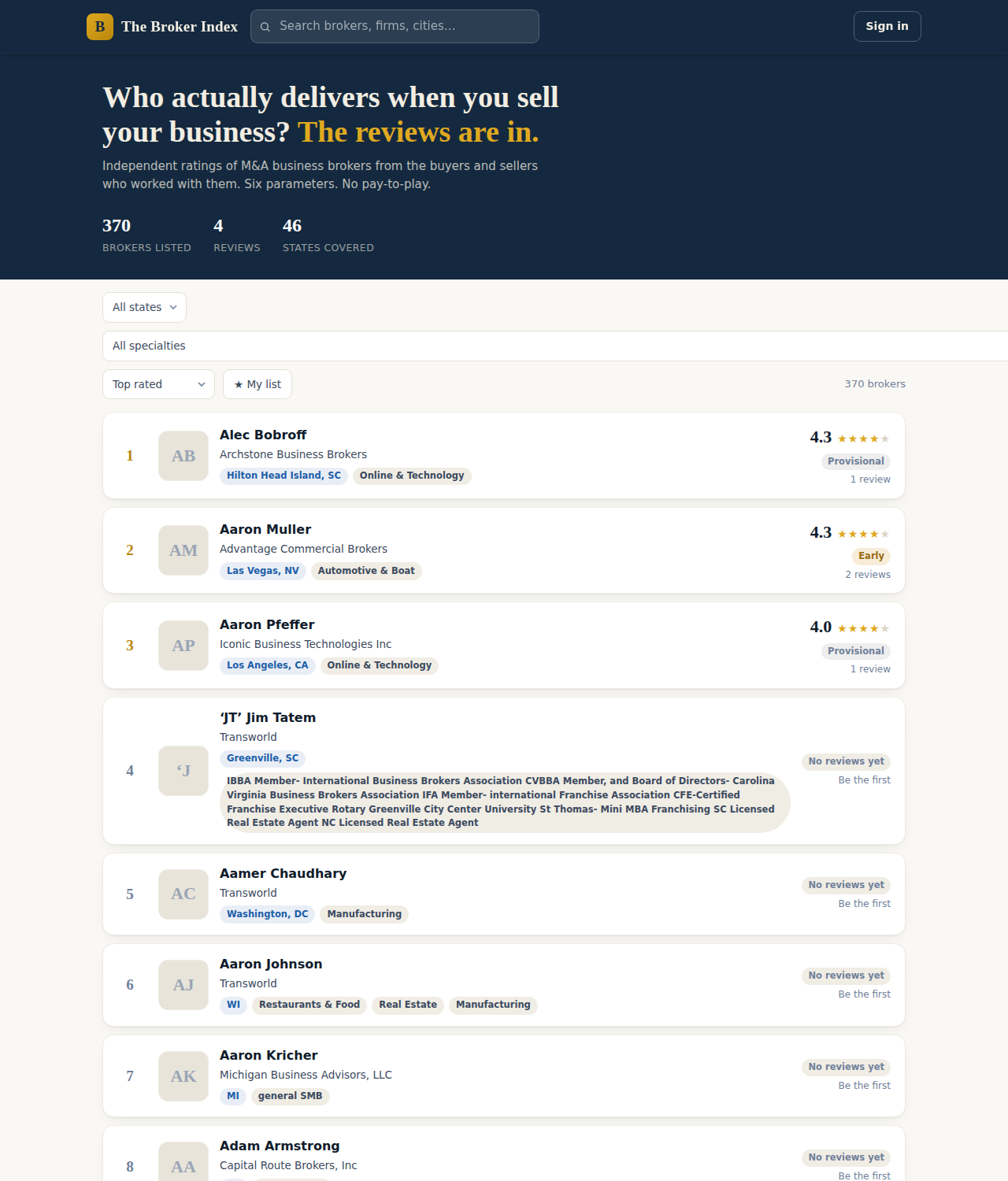
How to Use RateMyBusinessBroker.com to Find the Best Broker
A step-by-step walkthrough: filter hundreds of brokers by state and specialty, read six-parameter ratings, and leave reviews that count.